How much should you really save — 10%, 30%, or everything?
Three quiet strangers prove that patience beats brilliance every single time.
Key Takeaways (the 20-second version)
- Cover basics first — food, shelter, health, kids’ education. Luxury is not a basic need.
- Save 15–20%+ of your income once the basics are covered, and automate it.
- Pick your “freedom number” — the amount that lets you stop working if you chose to.
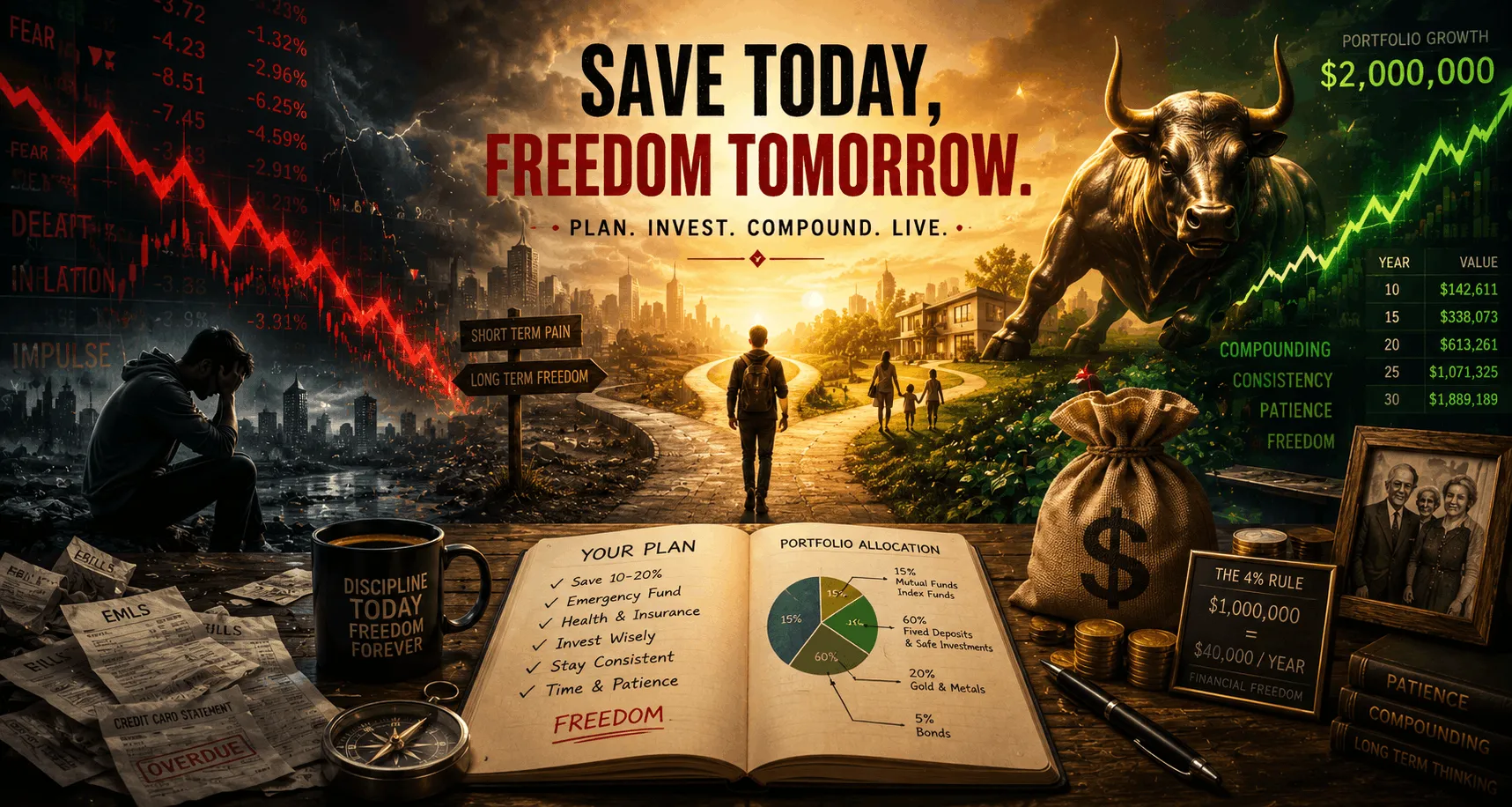
- The 4% rule: need $40k/year? Aim for ~$1M invested. Need $80k? Aim for ~$2M.
- Time beats timing. Consistent saving + reinvested dividends + decades = wealth.
- The 2008 warning: the ones who kept buying through the fear recovered; the ones who panic-sold stayed poor.
In one line: Save a little, automate it, hold for decades, don’t panic.
How Much Should You Save?
It all depends on what you really want. And honestly, until you’re at least 28 or 30, most of us aren’t fully settled. We don’t always know what we want in life yet. Still, we can come up with a rough plan. Why not? Who’s stopping you from dreaming about a Mercedes-Benz, or whatever version of that car means freedom and status to you?
Money, at its core, does a few simple things. It covers food, shelter, and clothing. Beyond that, it gives you the luxury of fulfilling wants: the apartment that raises your standing in the neighborhood, the car that makes you feel a bit more valuable, the trip around the world you’ve been putting off, or even the best bottle of wine you can find. It’s different for everyone. As a bachelor, those are the pictures that come to mind. A father might think first of his children’s tuition, wedding expenses, coaching classes, a solid house, good food on the table, and reliable healthcare.
So you sit down and pick a number. A realistic one. The amount that, if you had it in the bank today, would let you stop working for the rest of your life with zero regrets if you chose to.
You might still work a few more years because the people at the office are good company and you’re still single. Or you might get bored at home and pick up a side gig you actually enjoy. Or maybe you simply love the work you do.
Me? I love farming. I’m one hundred percent sure I’ll die as a farmer in my own field, transplanting the young paddy seedlings into the wet alluvial soil, legs sunk to the knees in mud.
Once you have your number, the next questions are practical. Can your current work get you there? How long will it take? At what age do you actually want the option to retire?
It gets complicated fast. So the simplest approach is this: cover your basics first, set aside something for health costs and kids’ education if that applies, make a few rough estimates, and use steady tools like fixed deposits or recurring deposits. That alone can cover a lot for most people—unless you live in a place where the local currency is collapsing the way Venezuela’s did during its worst hyperinflation years, when people turned to Bitcoin and other assets because the bolívar became almost worthless.
Or you can split the money across a few simple buckets. Something like 15% in mutual funds or broad index funds, 60% in fixed deposits or similar safe instruments, 20% in precious metals, and 5% in bonds. Every month you set aside a portion of what you earn and put it into these. In 10–15 years—around the time a child might need university money, or you’re ready to buy that house—you can start drawing on it.
Aim to save at least 10–20% once your basic needs are met.
Skipping meals for a year to save an extra thousand bucks is not smart.
Basics come first. Living in a luxury hotel or in the most expensive neighborhood is not a basic need.
Turning a Number into a Real Plan
The well-known 4% rule offers a useful starting point. If you can live on $40,000 a year in retirement (adjusted for inflation), you need roughly $1 million invested. If your lifestyle needs $80,000 a year, the target becomes $2 million. That is why my own number is two million dollars in cash. One million might work under the 4% rule, but I am very risk-averse, so I doubled it.
Fidelity’s long-standing research suggests aiming to save at least 15% of your income (including any employer match) if you start in your twenties. Historically, the S&P 500 has returned about 10% a year on average over long periods when dividends are reinvested. That is not a promise for the next decade, but it is the long-term record.
Imagine saving $500 a month starting at age 30 and earning an average 8% annual return after fees. In 25 years you would have roughly $475,000. Raise the monthly amount to $1,000 and the same period produces close to $950,000. Start earlier or save more aggressively and the numbers climb faster. The exact path depends on your income, location, and life stage, but the principle stays the same: consistent saving plus time does the heavy lifting.
Three Quiet Stories That Show What Is Possible
The scannable version (full stories below):
| Person | Job | Started with | Ended with | The move |
|---|---|---|---|---|
| Anne Scheiber | IRS auditor | ~$5,000 | $22 million | Bought quality stocks, reinvested every dividend, never sold |
| Grace Groner | Secretary | $180 (3 shares) | $7 million | Reinvested dividends for 75 years |
| Ronald Read | Gas attendant & janitor | Modest wage | $8 million | Blue-chips he understood, held for decades |
The punchline: none of them earned a big salary. None picked a hot tip. They just refused to sell.
Anne Scheiber worked as an auditor for the Internal Revenue Service. Despite being one of the sharper auditors in her office, she was never promoted. She never earned more than about $4,000 a year. In 1944, at age 51, she retired with roughly $5,000 in savings and a small pension. She lived in a modest rent-controlled apartment in New York, wore the same clothes for years, and rarely ate out.
What she did with her money was simple and relentless. She bought shares in solid companies, held them for decades, and reinvested every dividend. She avoided frequent trading so she would not trigger large capital-gains taxes. When she died in 1995 at the age of 101, her portfolio was worth $22 million. Almost the entire amount went to scholarships for women at Yeshiva University. She had started with almost nothing, earned a modest salary, and never chased hot tips. Time, patience, and reinvested dividends did the rest.
Grace Groner graduated from Lake Forest College during the Great Depression. She took a job as a secretary at Abbott Laboratories and stayed there for 43 years. In 1935 she used $180—serious money for a working woman at the time—to buy three shares of Abbott stock. She never sold them. Every time the company paid a dividend, she bought more shares. She lived frugally, drove an old car, and stayed in a small house.
When she died in 2010 at age 100, those three shares and the reinvested dividends had grown into more than $7 million. She left the fortune to her alma mater to fund scholarships. Almost no one around her knew she was wealthy. She simply bought a good company she understood, held on, and let compounding work for 75 years.
Ronald Read pumped gas and worked as a mechanic for decades in Brattleboro, Vermont. Later he took a part-time janitor job at a JCPenney store. He drove a used car, wore a coat held together with safety pins, and lived in a modest house. Neighbors saw a quiet, frugal man. What they did not see was the stack of stock certificates he kept in a safe-deposit box.
Read bought shares of blue-chip companies he understood—companies that paid reliable dividends—and held them for decades. He avoided technology stocks he did not understand. He never tried to time the market. When he died in 2014 at age 92, his estate was worth nearly $8 million. He left $4.8 million to the local hospital and $1.2 million to the public library. A gas-station attendant and janitor had quietly become one of the town’s largest philanthropists through simple, patient investing.
The Other Side of the Coin: 2008
Not every story ends in quiet millions. In 2008 the global financial crisis hit hard. The S&P 500 fell more than 50 percent from its peak. People who had spent years carefully building retirement accounts watched the numbers drop week after week. Some lost jobs. Others saw their small businesses dry up. The fear was real—and for many, the damage went far deeper than a temporary paper loss.
Julia was living in Melbourne, Florida, with her husband and two young children. In 2006 they had bought a house at the height of the boom. Their web-design business was doing well—together they were earning about $270,000 a year—and they had deliberately chosen a home that cost less than one year’s income so they wouldn’t overstretch. Everyone around them was pushing bigger houses and higher loans. “Everybody was buying… We kept hearing that the prices would go up so we’d better hurry,” she later recalled.
By 2008–2009 the work dried up. Clients stopped ordering custom websites. Then her husband panicked, took all the money they had left, and disappeared. Julia was suddenly alone with a two-year-old, a six-year-old, a large house she could no longer afford, heavy debt, and only a one-day-a-week nursing job. The house’s value fell to roughly half of what they had paid. Crime in the neighborhood exploded; the house was robbed five times even with a security system. In 2011 she filed for bankruptcy. Her credit score, once in the low 800s, crashed to around 400. A lawyer friend told her the only way forward was to stop paying the mortgage and let the house go into foreclosure. She did. It took her about six full years to rebuild her credit, put together a small emergency fund, and start saving for retirement again. Looking back she said simply: “Corporate America might get a bail-out, but no one was going to bail me out.”
Another couple’s story unfolded more slowly but cut just as deep. A woman later shared what happened to her family: they lost all their savings, both of their 401(k)s, and both of their investment properties. She lost her job. His business collapsed under the weight of the recession. The stress and financial pressure took a heavy toll on his health, and he eventually died. The only thing she managed to hold on to was their primary house, and even that remained a monthly struggle for years. “All he ever wanted was to be able to make the house payments without having to worry,” she wrote. When she finally makes the last payment, she plans to visit his grave and share a glass of wine with him.
These were not reckless gamblers or Wall Street insiders. They were ordinary people who had done many of the “right” things—bought homes, built businesses, saved in retirement accounts—only to watch it unravel when the system seized up. Many others sold near the bottom, locked in losses of 40 percent or more, and moved what little remained into cash accounts that paid almost nothing. Years later, when the market recovered and climbed to new highs, those who had sold were often still sitting on the sidelines, the emotional scar of watching a portfolio cut in half making it almost impossible to get back in.
The people who kept buying a little every month through the fear eventually saw their accounts recover and grow far beyond the pre-crisis levels. The difference was rarely intelligence. It was the ability to stick to a plan when everything felt like it was collapsing—and the painful reminder that even careful plans can be tested harder than most of us ever expect.
More thoughts on money.
Sometimes I feel, you don’t really need to invest any money, it just depends on how much money you’re actually spending every month, how many bills are you paying? why are you paying? can you cut them off? Do you really need that subscription? Are you actually using everything that you own or rented? Can you bring it down? Or do you want all of it?
All these questions we’ll try to answer in the next post,
6H Law by Charlie
where in I am going to break down the 6H Law—Charlie’s straightforward framework that cuts through all the noise:
How much you spend.
How you spend.
How much you earn.
How you earn.
How much you save.
How you save.
Six levers. That’s it. Master them and the money questions stop feeling complicated. Miss them and no amount of fancy advice will save you.
The first one hits harder than most people expect.
Bonus Tip
Before you chase a higher return, kill one silent leak. Cancel a single subscription you forgot you had and redirect that money into an automatic monthly transfer. A boring $50/month, invested and left alone, quietly outperforms most “hot tips” — because you never have to remember to do it again.
The One Line to Remember
Time in the market beats timing the market. Anne, Grace, and Ronald didn’t predict anything — they just held on.
New here? Start with the basics: What Is Money? Barter, Currency & Inflation Explained — then come back for the 6H Law.
Stay tuned!