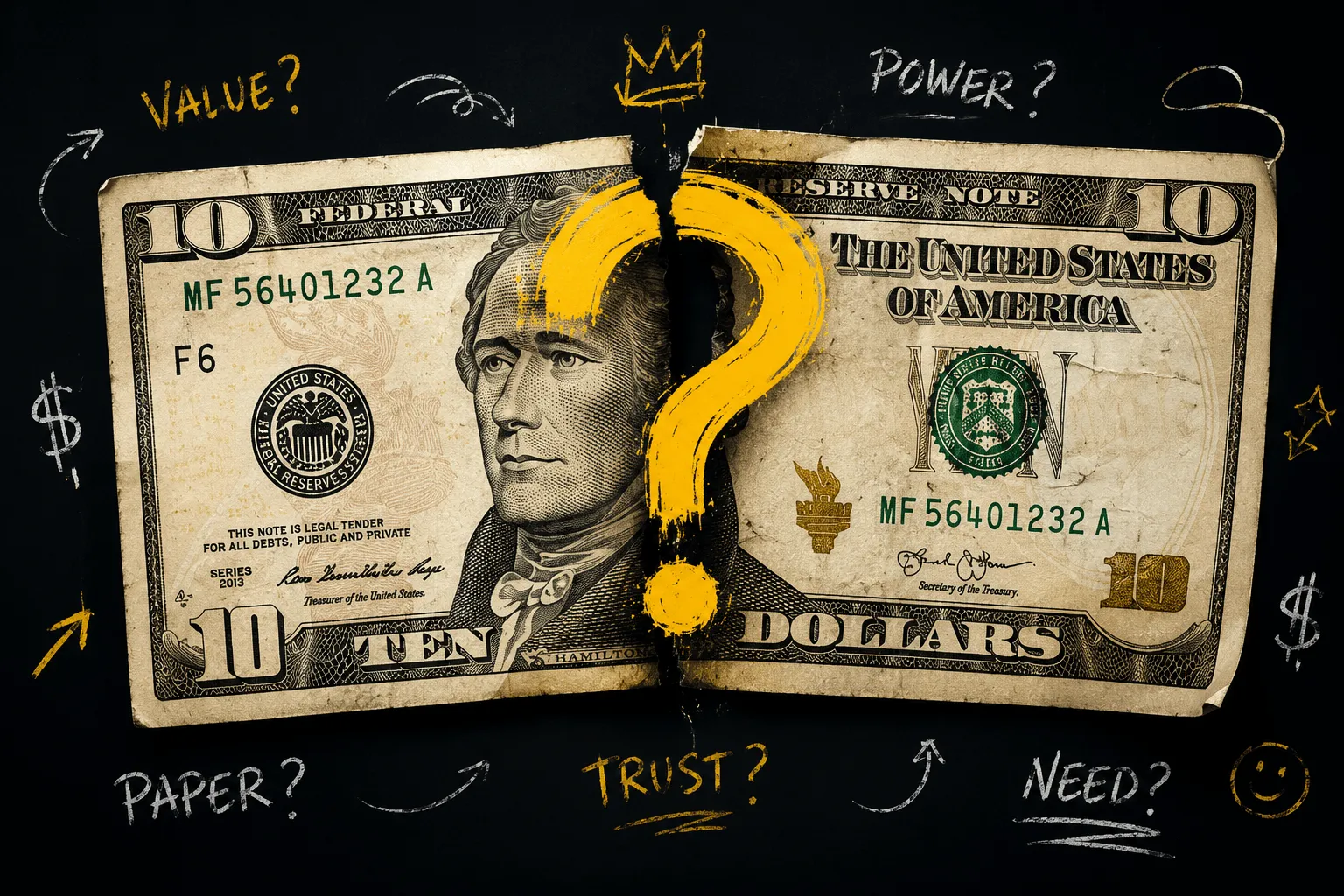
What actually makes a ten-dollar bill worth ten dollars?
It's not gold. It's not the government. It's something far stranger — trust.
Key Takeaways (the 20-second version)
- Barter came first — swap goods directly, but only if both people want what the other has.
- Money = anything everyone agrees has value, so buying and selling gets easy.
- Currency = money printed and authorised by a government — not by you.
- Inflation = too much money chasing too few goods → prices rise, cash buys less.
- The real answer: money isn’t paper or gold. It’s trust.
The whole story in one line: Barter → Coins → Currency → Inflation.
| Stage | What it solved | New problem it created |
|---|---|---|
| Barter | — | Needs a “double coincidence of wants” |
| Money | Made trade easy | — |
| Currency | Standardised, government-backed | Can be over-printed |
| Inflation | — | Money quietly loses value |
I still remember that Tuesday morning as clearly as if it happened yesterday.
The Day the Class Turned Into Chaos
It was eighth grade. Social Studies. Mr. Benjamin Brock’s class.
The clock had already crossed ten minutes past the period’s start, and the classroom had transformed into what every classroom naturally becomes when a teacher is late. Controlled chaos. Some kids were throwing paper balls. A few were arguing over cricket. Someone at the back was humming a movie song while drumming on the desk. I was leaning back in my chair, absentmindedly spinning my pencil.
Then the classroom door opened. Mr. Brock walked in. But he wasn’t alone. A woman, probably in her early thirties, followed him carrying a stack of papers and a small cloth bag. The class slowly quietened. I recognized her immediately.
“Wait… isn’t she the Economics professor?”
I had seen her around school before. She smiled while saying something to Mr. Brock, and he laughed. Beside me, Sam nudged my shoulder. “Maybe they’re friends.”
“Could be.”
He narrowed his eyes dramatically.
“No…”
“What?”
“They’re definitely friends.”
I rolled my eyes.
“They’re literally talking.”
“Exactly!”
“They’re standing so close.”
“So?”
“And she’s a woman.”
”…”
“So she’s his girlfriend.”
“WHAT?!”
The word escaped my mouth far louder than I intended. The entire classroom froze. Both teachers looked at me. Mr. Brock blinked. “Charlie…”
“Are you okay?”
Twenty-five students turned toward me. I wished the floor would simply open and swallow me.
“Y-Yes, sir…”
“Sorry…”
Mr. Brock gave me a puzzled smile before facing the class.
“Good morning, everyone.”
“Good morning, sir…” the class replied.
“This is Ms. Linda. She’s from the Economics department and she’ll be taking today’s guest session.”
He stepped aside. Linda smiled brightly.
“Good morning, everyone!”
“Good morning, ma’am!”
While she arranged a few things on the teacher’s desk, Sam leaned toward me again.
“I told you.”
“What now?”
“They’re dating.”
“Oh, stop it, you idiot.”
“He’s like fifty!”
“So?”
“Can’t people be fifty and have girlfriends?”
I sighed.
“Fine.”
“You win.”
“She’s his girlfriend.”
“Happy?”
Sam grinned victoriously.
“I knew it.”
“Now listen to the lecture.”
“You’re such an asshole, Sammy.”
I whispered it just loud enough for him to hear. Unfortunately…
Someone else heard it too. Ms. Linda looked directly at me. “Charlie?”
My heart stopped. “Yes… ma’am?”
“Would you mind helping me with today’s demonstration?”
Sam slowly leaned back in his chair with the biggest grin imaginable. “You’re dead, bro.”
I closed my eyes for half a second.
“Fantastic.”
I walked to the front of the classroom while every single student watched me. Linda handed me two packets of bread.
”…Bread?” I muttered to myself.
She smiled. “Just trust me.”
Barter, Before Money Existed
Then she looked at the class. “Today we’re going to answer one very simple question.”
She held up a crisp ten-dollar bill.
“What is money?”
She waved the note gently. “What do we call this?”
“Money!” the class answered together.
“Exactly.”
“And what do we use it for?”
She pointed toward Sam. His eyes widened.
“Oh…”
“Uh…”
“To buy things.”
“What kind of things?”
He glanced at the bread in my hands. ”…Bread.”
The whole class laughed.
”…And chocolates.”
Linda nodded. “Perfect.”
“Money helps us buy the things we need or want.”
She placed the bill on the desk. “But…”
“What if money didn’t exist?”
Silence.
“A long time ago, people exchanged goods and services directly. This system was called barter.”
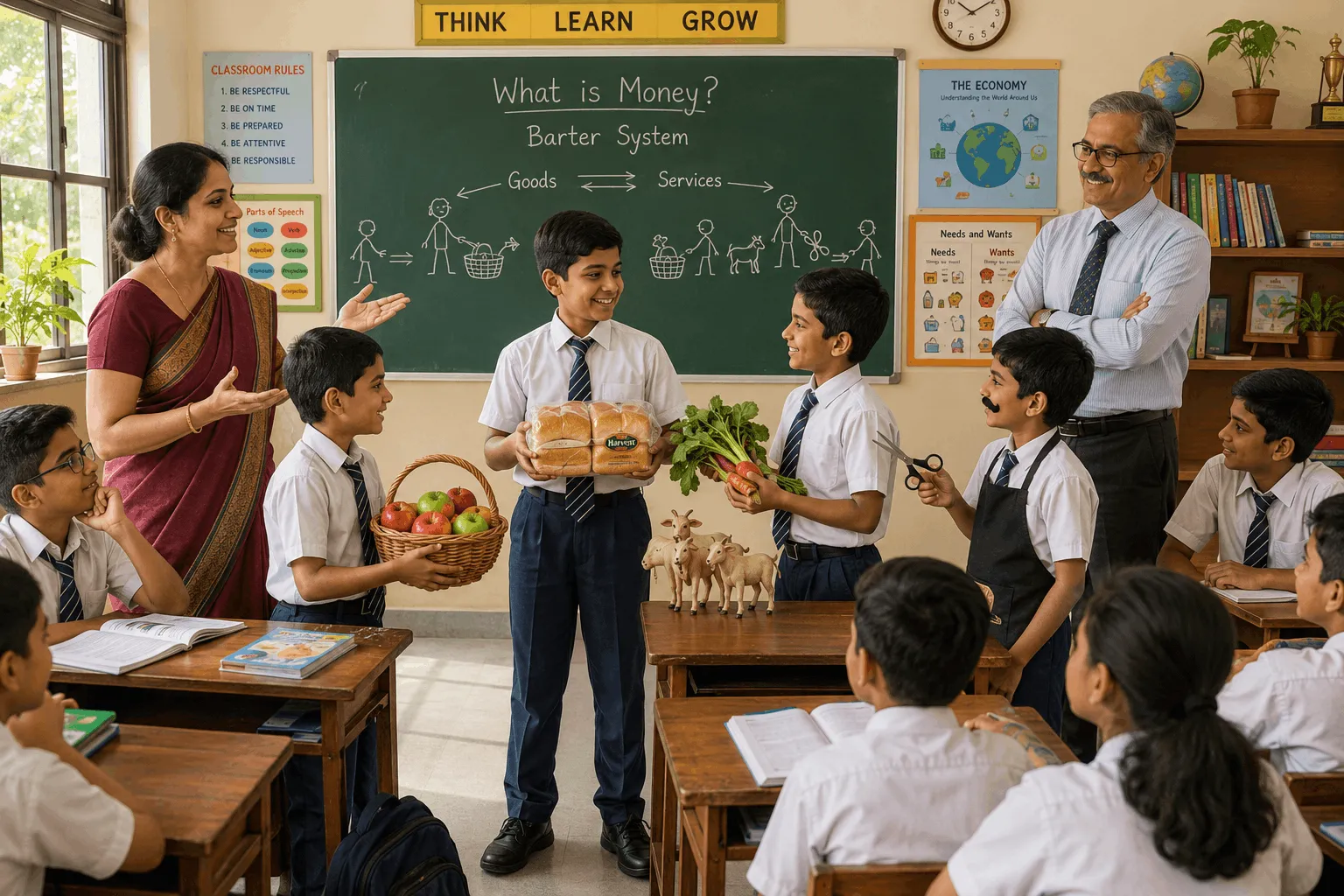
Barter worked, but only when both people wanted exactly what the other had.
She looked around. “I’ll need four more volunteers.”
Hands shot into the air. Within a minute, four students stood beside me. Linda quickly arranged us in a line. She handed one student a toy basket filled with plastic apples. Another received a small bag of toy vegetables. The third held three toy goats made from cardboard. The fourth wore a funny paper moustache and held a toy pair of scissors.
“The barber,” she announced. The class burst into laughter. She pointed toward me. “Charlie is our baker.”
She lifted one bread packet. “Charlie has bread.”
Turning to me, she smiled. “Charlie, trade one packet.”
I handed the bread to the first student. He gave me the basket of apples.
“Great!”
“So Charlie wanted apples.”
“No money.”
“Just exchange.”
She pointed again. “Now Charlie wants vegetables.”
I traded my apples for vegetables. Again.
“No money.”
Then I exchanged the vegetables for the three toy goats. The class laughed seeing me awkwardly trying to hold three cardboard goats. Finally Linda pointed toward the barber.
“Charlie now wants a haircut.”
The barber spread his hands dramatically.
“I don’t need goats.”
“I need food.”
“So what can Charlie do?”
The class answered almost together. “Give bread!”
I handed over my second bread packet. The barber pretended to cut my hair.
Snip. Snip. Snip.
Everyone laughed.
Linda clapped once. “Excellent.”
“Did anyone use money?”
“No!”
“What did we use?”
“Things!”
“Exactly.”
She looked around the room. “But imagine carrying goats…”
“…bread…”
“…vegetables…”
“…and apples…”
“…everywhere you go.”
The students laughed again.
“Not very convenient, right?”
“No!”
“So people slowly started using something everyone agreed had value.”
She opened a small pouch and poured a handful of shiny plastic gold coins into my hands.
“Charlie now sells all his bread to a shop.”
“The shop gives him gold coins.”
She took away the remaining props. Now I simply held the coins.
“Now Charlie wants apples.”
Instead of exchanging bread… I handed over two coins. The student gave me the apples.
“Now vegetables.”
Two more coins. “Now a haircut.”
One coin.
Snip. Snip. Snip.
Linda smiled. “Much easier.”
Everyone nodded. She held up one of the coins.
“Money is something everyone agrees has value, so people can easily buy and sell goods and services.”
Even I understood it instantly. Then she reached into her notebook. She tore out a blank sheet of paper. With a marker she wrote… $10 …inside a rough rectangle. Holding it high, she asked, “So…”
“Is this money?”
The class answered confidently. “No!”
“Why not?”
One girl raised her hand. “Because you just made it.”
“Correct.”
Linda nodded. “Our real money is called currency.”
“It is printed only by the government through its authorized system, not by ordinary people.”
I raised my hand. “Ma’am?”
“Yes, Charlie?”
“If printing money is so useful…”
“…why don’t we just print unlimited money?”
Mr. Brock slowly looked toward the ceiling. Without changing his expression he quietly said,
”…Inflation.”
(Author note: I hate this thing, it’s the culprit of all banking, stock market and savings, gambles and what not?, life would be so simple without it!)
Linda smiled. “Exactly.”
“But instead of telling you… let’s see it.”
Why Printing More Money Backfires
She quickly looked around the classroom. “I need one shopkeeper.”
One student volunteered. She placed five chocolates on his desk.
“These chocolates are for sale.”
She gave me one paper dollar. “You have one dollar.”
She gave another student one dollar. “And you have one dollar.”
“How much should one chocolate cost?”
The shopkeeper thought. “One dollar.”
“Perfect.”
Both of us bought one chocolate. Simple. Fair. Then Linda suddenly pulled out a stack of fake paper notes from her folder. She started handing them to everyone.
“You get ten dollars.”
“You get ten.”
“You too.”
“You too.”
Within seconds almost every student was waving fake money in the air. “Now…”
She smiled mischievously. “Everyone…”
“Buy chocolates!”
The classroom exploded. “I want one!”
“Me first!”
“I’ll pay two dollars!”
“I’ll pay five!”
“I’ll pay ten!”
The poor shopkeeper looked completely overwhelmed.
“There are only three chocolates left!”
Someone shouted, “I’ll give twenty dollars!”
Another yelled, “I’ll pay thirty!”
Linda turned toward the shopkeeper. “What do you do now?”
He grinned. “I’ll increase the price!”
“How much?”
“Twenty dollars!”
The room erupted with laughter.
Linda raised her hand for silence.
“Did the chocolates become better?”
“No!”
“Did we make more chocolates?”
“No!”
“So why did the price go up?”
This time nearly everyone answered together. “Because everyone had more money!”
“Exactly.”
She nodded proudly. “When too much money chases too few goods, prices rise.”
“That’s called inflation.”
She paused just long enough for the words to settle.
“Inflation means money loses some of its buying power because prices of things keep increasing.”
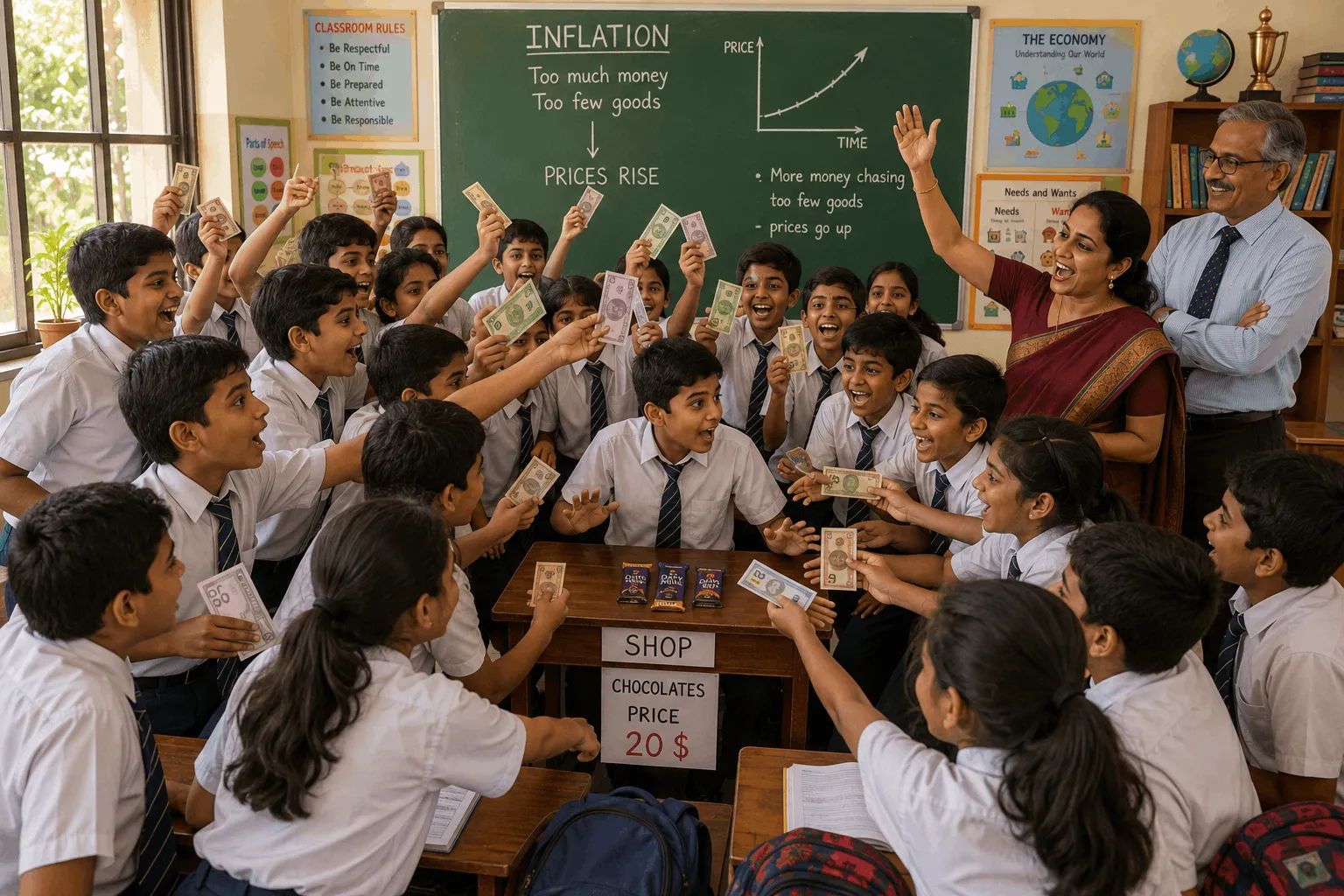
Too much money chasing too few goods: same chocolates, higher prices.
The classroom became surprisingly quiet. Even the kids who usually never listened were paying attention.
Mr. Brock slowly began clapping. Once. Twice. Then louder. The rest of the class stood almost instinctively. The applause filled the room. Linda looked genuinely touched. She laughed softly and bowed her head.
“Thank you, everyone.”
Just then—
TRRRRRRRR!
The school bell rang. Books snapped shut. Chairs scraped across the floor. The spell of the lesson broke as students rushed toward the door. Sam caught up beside me in the corridor.
“You know…”
“What?”
“That was actually fun.”
I smiled.
“Yeah.”
Then he smirked.
“But…”
“I still think Brock sir is dating Linda ma’am.”
I stared at him for a second. Then burst out laughing.
What Stayed With Me
Some people, I realized, learn about money… And some never stop investing in nonsense.
Author note: Man… I myself hate investing, what for? I will work until I die, so I don’t really need a so called retirement-plan, the only thing that worries me is freedom, freedom of doing whatever I want irrespective of how much I make?
Fun fact: During World War II, cigarettes became real money inside prisoner-of-war camps — even non-smokers hoarded them. Anything a group trusts can become money.
Bonus Tip
Watch your real returns, not the number on the screen. If your savings grow 4% a year but inflation runs at 6%, you’re quietly getting poorer while feeling richer. Inflation is the silent tax nobody sends you a bill for.
The One Line to Remember
Money = trust you can spend. The moment trust grows faster than goods, prices rise — that’s inflation.
Want to know how much of that “trust” you should actually keep? Read the follow-up: Money Talks — How Much Should You Really Save?